
I describe myself as a forensic SEO consultant, and people often ask what that actually means. Fair question. “Forensic SEO” is not an official Google term. It is a name practitioners use for one specific kind of work: investigating lost or stalled organic growth with evidence instead of opinion. Search Engine Journal and other industry publications use it the same way.
In more than 12 years of SEO, including 21,000+ hours and 100+ projects as a Top Rated Plus consultant on Upwork, the most expensive mistakes I have seen were not caused by a lack of effort. They were caused by fixing the wrong thing. Forensic SEO exists to prevent that.
Forensic SEO vs a standard SEO audit
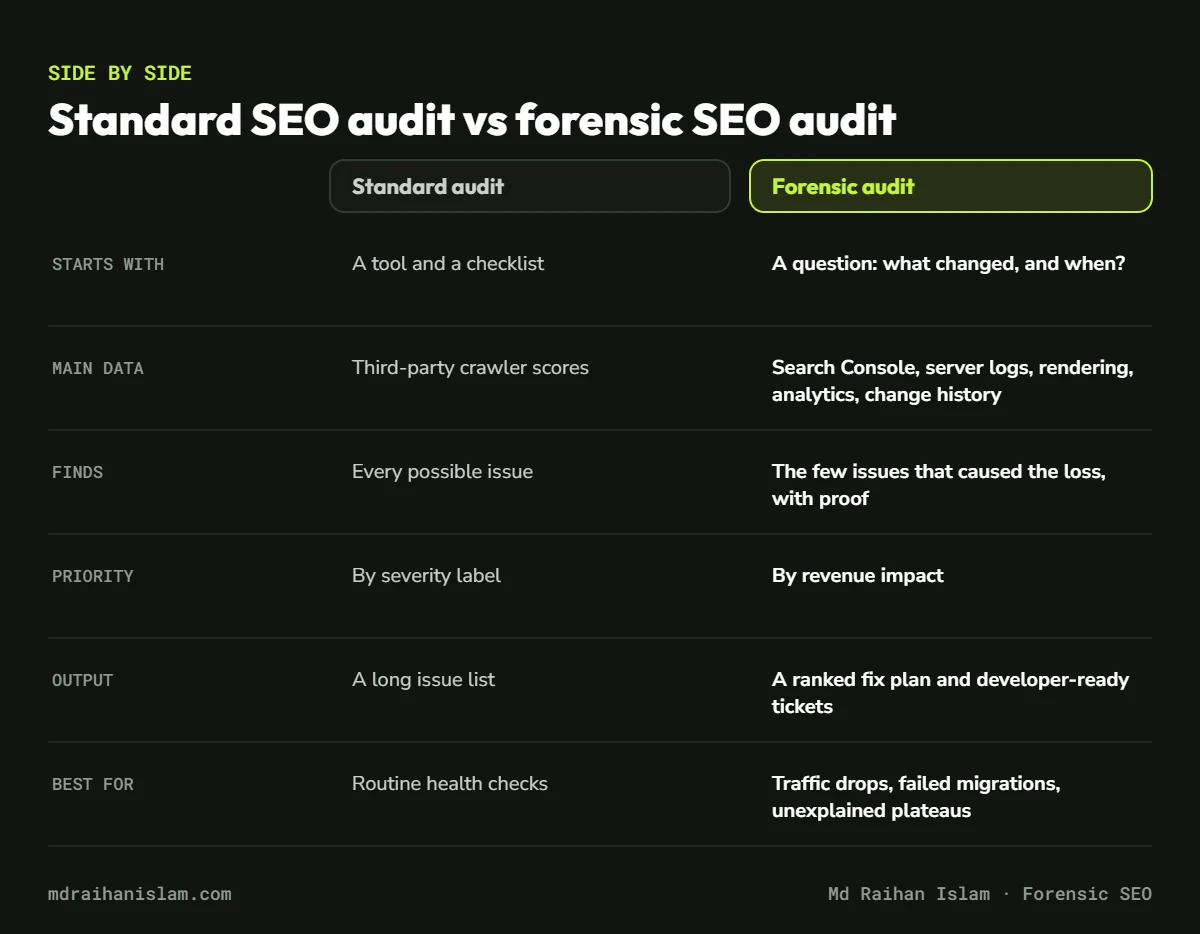
A standard SEO audit asks “what is wrong with this site?” and returns a list of everything a crawler can find. A forensic SEO audit asks “what changed, when, and why did it cost us traffic?” and returns the few issues that actually caused the loss, with proof.
| Standard SEO audit | Forensic SEO audit | |
|---|---|---|
| Starts with | A tool and a checklist | A question: what changed, and when? |
| Main data | Third-party crawler scores | Search Console, server logs, rendering, analytics, change history |
| Finds | Every possible issue | The few issues that caused the loss |
| Prioritized by | Severity labels | Revenue impact |
| Output | A long issue list | A ranked fix plan and developer-ready tickets |
| Best for | Routine health checks | Traffic drops, failed migrations, plateaus |
Both have a place. A routine audit is a health check. A forensic audit is a diagnosis, and you need it when something has already gone wrong and nobody can explain why.
The six sources of evidence
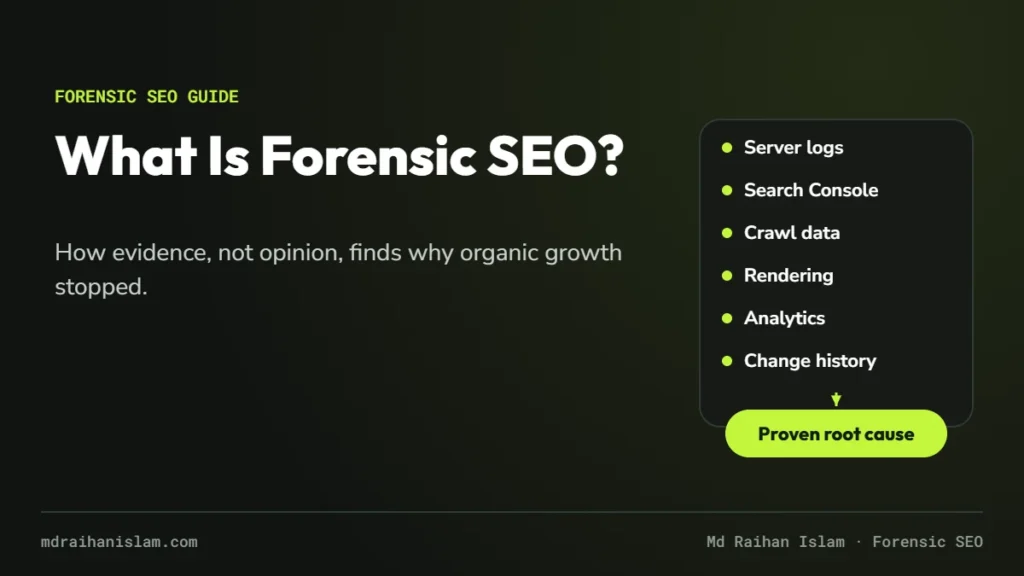
Opinions are cheap in SEO. Evidence is not. In every investigation I cross-check six sources, because each one shows a different part of the truth:
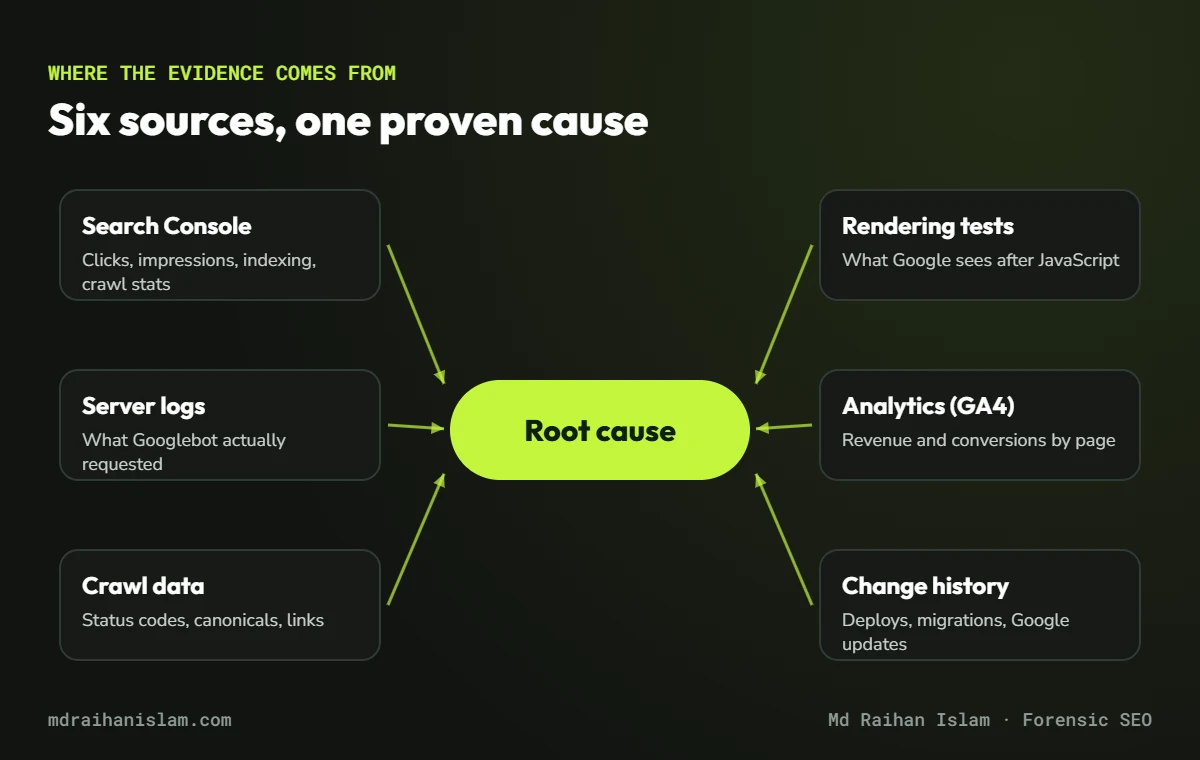
- Google Search Console. Clicks, impressions and positions by page and query, the Page indexing report, Crawl stats, Manual actions and the URL Inspection tool. This is Google telling you what it sees.
- Server logs. Every request Googlebot actually made. Crawler tools simulate a visit; logs record the real ones, including pages Google wastes time on and pages it ignores.
- Crawl data. Status codes, canonicals, redirects and internal links across the whole site, so you can spot patterns caused by one template.
- Rendering tests. What Google sees after JavaScript runs. Content that looks fine in a browser can be missing from the rendered HTML.
- Analytics. Revenue and conversions by landing page, so fixes are prioritized by money, not by the length of an issue list.
- Change history. Deploys, plugin updates, migrations and confirmed Google updates from the Search Status Dashboard. Most drops start the day something changed.
Raihan’s tip
Two sources, or it is not proof
Never call something the cause until two independent sources agree. A crawler warning on its own is a hint. A crawler warning backed by Search Console data or your server logs is evidence. When the sources disagree, keep digging instead of fixing.
How a forensic SEO investigation works
This is the framework I use with every client, whether it is a single-location clinic or an enterprise ecommerce site:
- Discovery. Your business model, revenue channels and what search is actually worth to you.
- Investigation. Crawl, index, rendering, logs, links and content, measured against the date the problem started.
- Prioritization. What is broken, what it costs, and what gets fixed first for the fastest revenue impact.
- Implementation. Precise fixes, shipped safely with your developers or hands-on by me.
- Measurement. Recovery proven in your own Search Console and GA4, not in a slide deck.
- Growth. Once the foundation holds: content, authority and AI search visibility.
If you want to try the first part of this on your own site, my forensic checklist for a website traffic drop walks through it step by step.
When you need forensic SEO
- Organic traffic or revenue dropped suddenly and nobody can explain why.
- Traffic fell after a migration, redesign or replatforming.
- Growth has flatlined even though audit tools say the site is “healthy”.
- Important pages fell out of Google’s index or never got in. See my guide to Discovered – currently not indexed.
- You have already paid for two or three audits and still don’t have an answer.
- A drop lines up with a Google core update and you need to know what to change, if anything.
A real example: the healthy score that hid the problem
One Shopify store came to me with a 96 out of 100 score from a popular audit tool. In Google’s own data, mobile speed scored 40 and hundreds of pages were not indexed. Fixing those first led to a 343% increase in organic search revenue within 30 days, as measured in GA4. Another long-established ecommerce brand had technical debt nobody had diagnosed for years; after we rebuilt the technical foundation, its technical health score went from 69% to 92% and ranked keywords grew from 2,642 to 7,280 between November 2022 and April 2023. Both are in my SEO case studies.
The principles behind the method
- Evidence over opinion. A cause is not a cause until the data shows it.
- Prove before you fix. Random fixes create new problems and destroy the evidence.
- One change at a time. So you know what worked.
- Revenue first. The page that earns money gets fixed before the page that merely has the most warnings.
- Honest answers. Sometimes the fix is small enough for your own team. A good forensic consultant tells you that.
“We recommend avoiding making radical changes if your page is already performing well.”
Google Search Central, Debugging drops in Google Search traffic
Google’s own advice points the same way. Its guidance on helpful, reliable content asks site owners to self-assess honestly, and its core updates documentation warns against quick fixes. Forensic SEO is simply that mindset applied with better data.
Want a forensic investigation of your site?
My Forensic SEO Audit proves why organic growth stopped and ranks every fix by revenue impact, with developer-ready tickets. It starts with a free 30-minute call.
You can also read more about how I work as a forensic SEO consultant for businesses in the US and UK.
FAQ
Is forensic SEO the same as an SEO audit?
No. A standard audit lists everything a crawler can find. A forensic SEO audit investigates a specific problem, such as a traffic drop, and proves which few issues caused it using Search Console, server logs, rendering and analytics.
How long does a forensic SEO audit take?
Most of my forensic SEO audits take two to four weeks, depending on site size and how much historical data is available.
How much does a forensic SEO audit cost?
My forensic SEO audits start at $2,500, and the fee includes a revenue-ranked fix plan with developer-ready tickets. The full breakdown is on the Forensic SEO Audit page.
What access does a forensic SEO consultant need?
Read access to Google Search Console and GA4 is enough to start. Server logs and a change history make the investigation faster and more precise. I sign NDAs before receiving any data.
Can forensic SEO help with AI search visibility?
Yes. The same method explains why AI Overviews, ChatGPT or Perplexity cite a competitor instead of you: entity signals, structured data, crawl access and content that answers the question directly.