
Local SEO Consultant
Customers in your area are searching for exactly what you do and calling somebody else. I diagnose the whole local search system behind that, not just your listing.
4.9 ★★★★★
36 verified reviews
12 years
In SEO
Search Central featured
I take a limited number of these each month. If your business isn't a fit, I'll say so on the call rather than send a proposal.
No contract · No obligation · You’ll know where you stand either way
36 verified reviews from Upwork
In SEO
Featured in Google Search Central

Before anything else
I know, because almost every business owner I speak to mentions it. So let’s clear that up first.
I’m not one of those people and this works differently.
You came here. I don't buy lists or dial businesses hoping someone picks up.
Long contracts exist to protect the agency, not you. If the work isn't earning, you shouldn't be trapped in it.
Nobody can guarantee a ranking. Anyone who does is either guessing or selling. I'll show you what's realistic instead.
Ecommerce SEO
Sales are flat while ad costs climb. Somewhere across thousands of product and category pages, organic revenue is leaking, and nobody can point to where.
Ecommerce is where I have spent most of my career. Faceted navigation burning crawl budget, product pages Google never indexes, category pages competing with each other, duplicate variants, and schema that does not tell AI engines what you sell.
Shopify, BigCommerce, Magento, WooCommerce or custom builds. With full stack and server level experience, I fix things at the root instead of patching the surface.
Local SEO
Your competitors sit in the Google Maps three pack while you are somewhere below it. The phone rings less than it should, and the customers are right there in your area.
Local visibility is not a listings checklist. It is technical health, a properly optimised Google Business Profile, location pages built to rank, consistent citations, and a review flow that keeps generating trust without you chasing it.
This is one of my strongest areas, with case studies to show for it, from single locations to multi location businesses.
Optometry · New Jersey
organic traffic in 90 days
website clicks from search
Problem: Bergen Optometry had low visibility in a crowded local market. Nearby patients searching for an optometrist were finding practices that simply appeared first.
Approach: Optometry-specific local SEO combined with the underlying technical work not a citations checklist.
Result: A move from low visibility to a dominant position in the Google Maps local pack, inside a single quarter.

Who I help
Local SEO pays back fastest when a single new customer covers months of the work. These are the businesses where that’s true.
Siding, windows, gutters. Seasonal demand, high job value, brutal map competition.
Kitchen, bath, whole-home. Long consideration cycles, big ticket sizes.
Water and fire damage, mold, commercial cleaning.
Repeat customers and service contracts. Service-area setup is usually where these go wrong.
General practice through to implant and cosmetic cases worth thousands each.
Where the case study above came from. Exams, frames and specialist procedures.
Injectables, laser, body treatments. High lifetime value, heavy local competition.
Personal injury, family, criminal defense. A single case can justify a year of local SEO.
The diagnosis
Six things I find over and over. None of them are obvious from the outside, which is why nobody has told you yet.
01
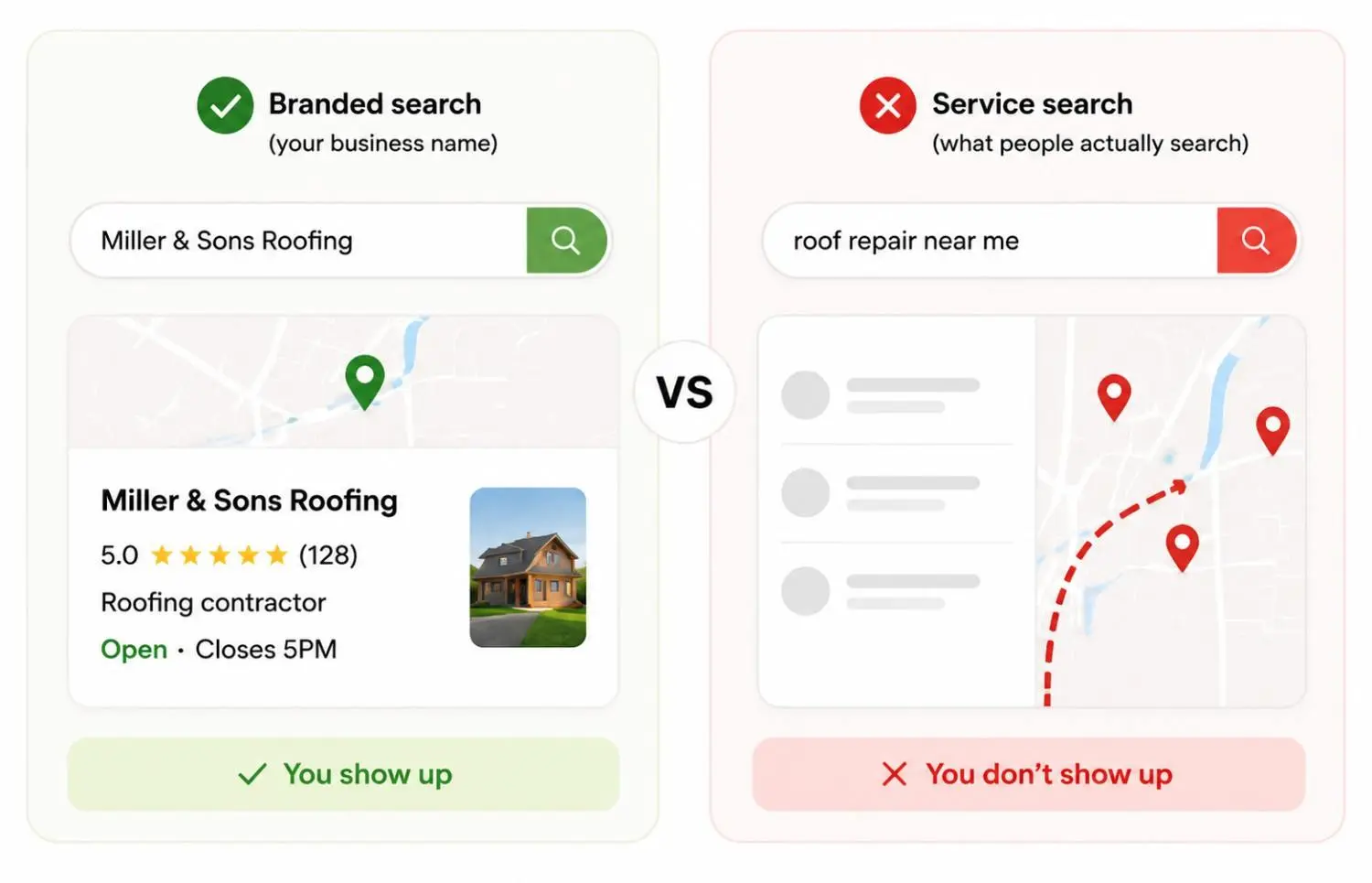
Search your own name and you’re there, so everything looks fine. Search “roof repair near me” or “emergency dentist” and you’re nowhere. Those are two completely different problems and only one of them brings new customers.
Underneath: Google Business Profile categories, services and attributes are usually incomplete or wrong.
02
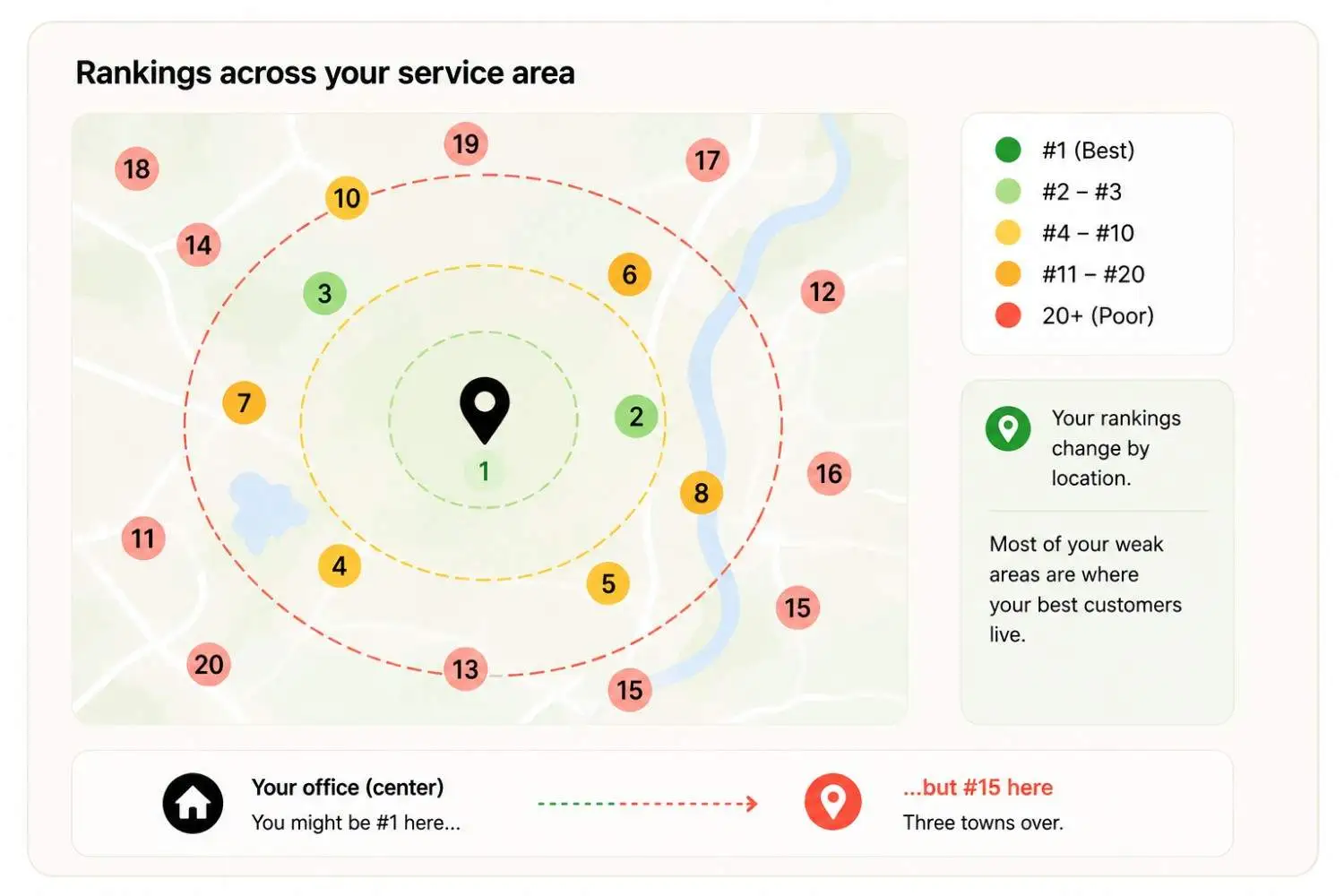
Local rankings change street by street. You might sit at the top of the map for people searching from your own block, and be invisible three towns over — the towns you actually want to serve.
Underneath: service area setup, proximity signals, and no location-specific pages to anchor the surrounding towns.
03
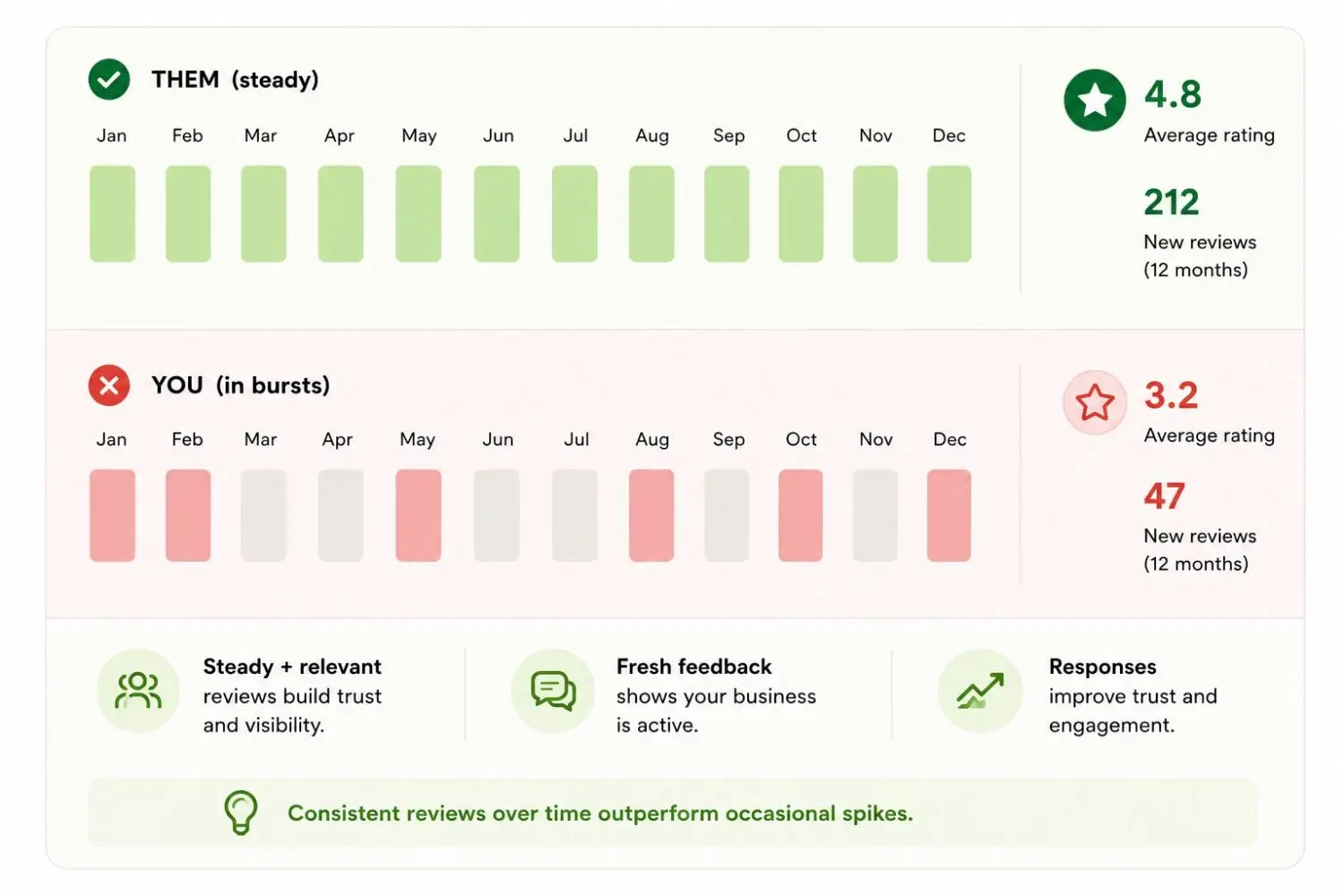
A large review count doesn’t automatically win. Quantity, recency, relevance and the overall strength of your review profile all matter and responding shows customers and Google alike that the business is active and engaged. None of it happens on its own: if review requests aren’t built into how you close a job, they aren’t happening.
Underneath: no review generation system, unanswered reviews, and feedback too generic to signal what you actually do.
04
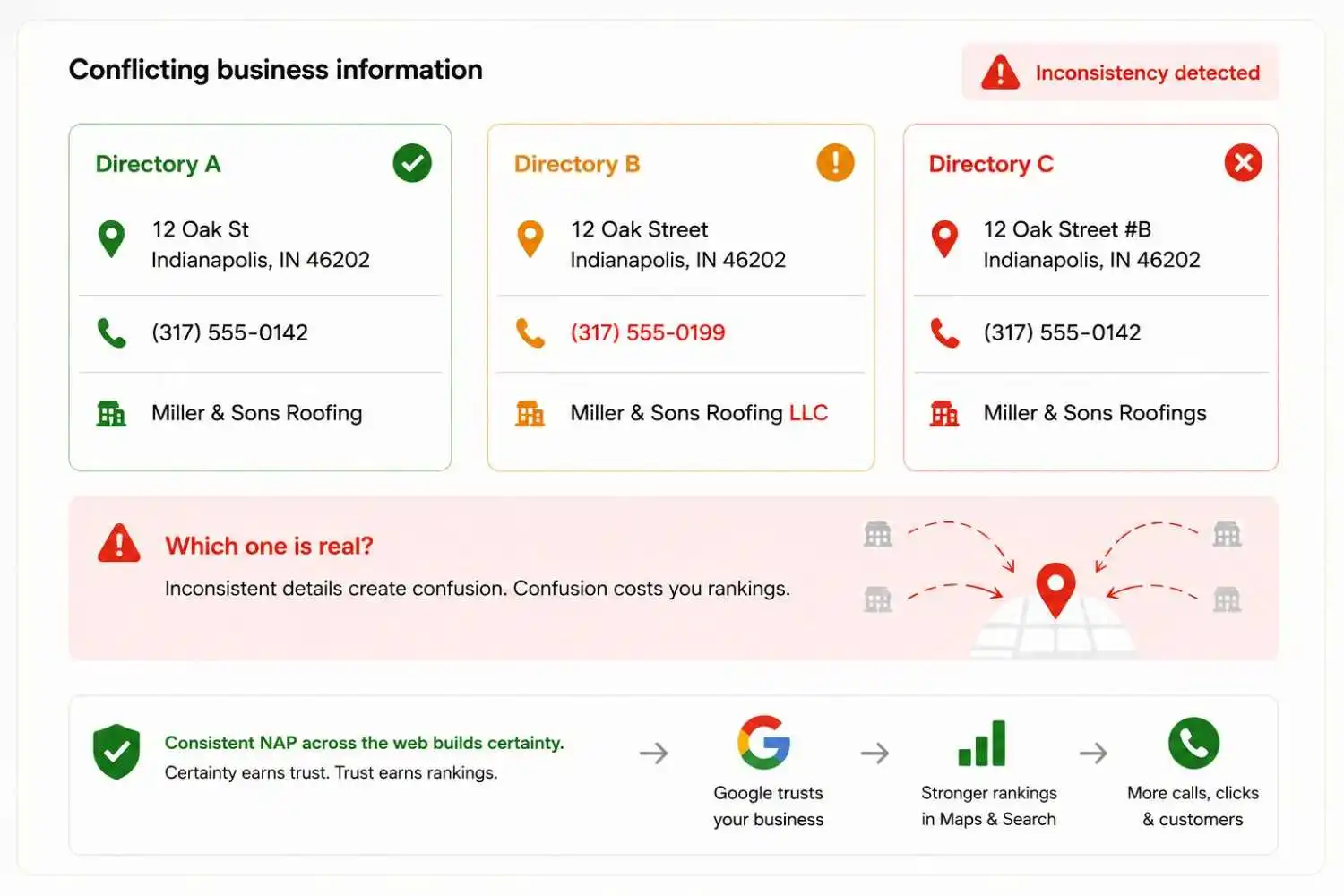
An old address on one directory, a disconnected phone number on another, a slightly different business name on a third. Every mismatch makes Google a little less certain you’re the same business and certainty is what it’s ranking on.
Underneath: inconsistent NAP data across citations, aggregators and old listings.
05
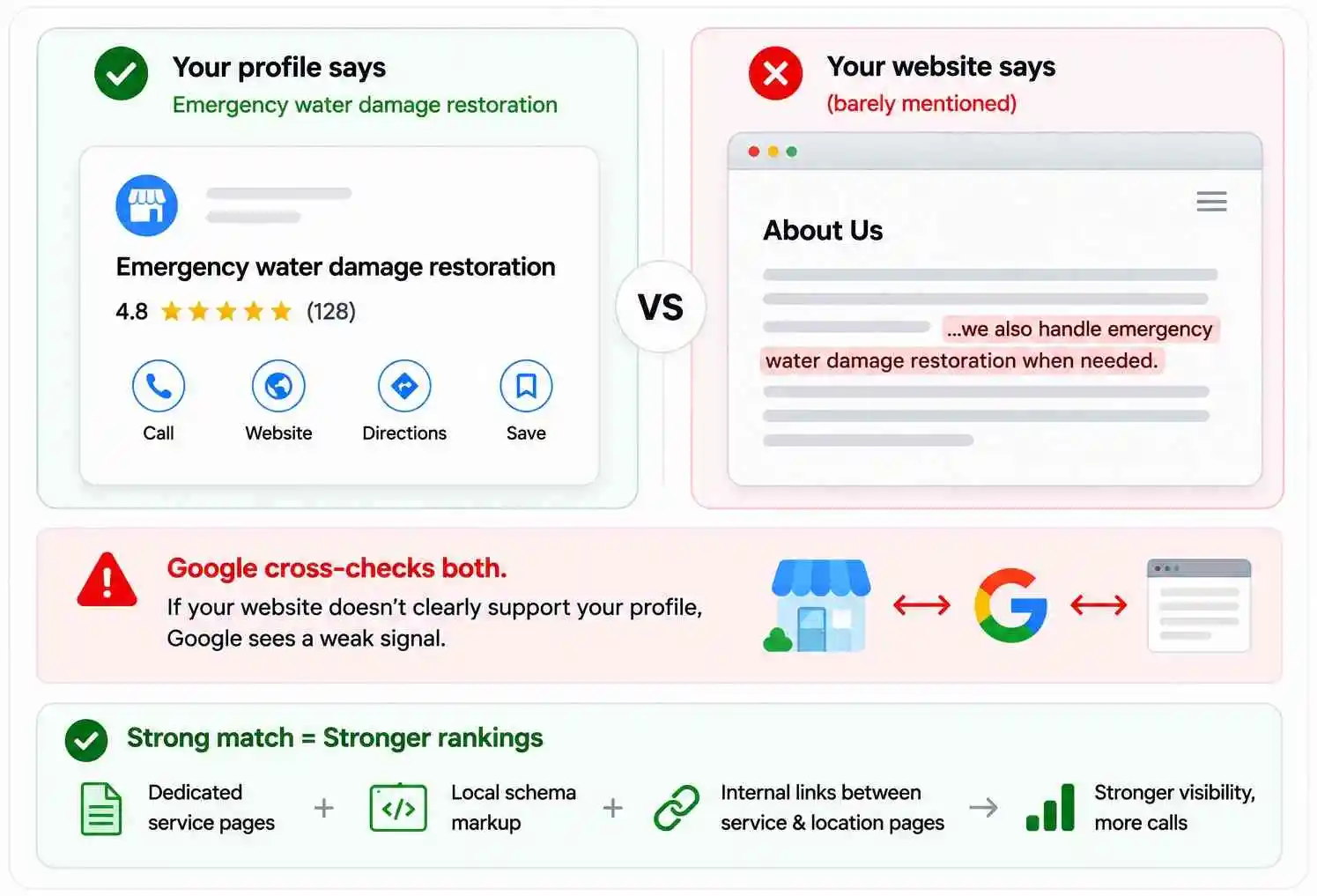
Your listing says you do emergency water damage restoration. Your website mentions it once, in a paragraph, on a page about something else. Google cross-checks the two, and thin pages undercut a strong profile.
Underneath: missing service pages, no local schema, and no internal linking between service and location pages.
06
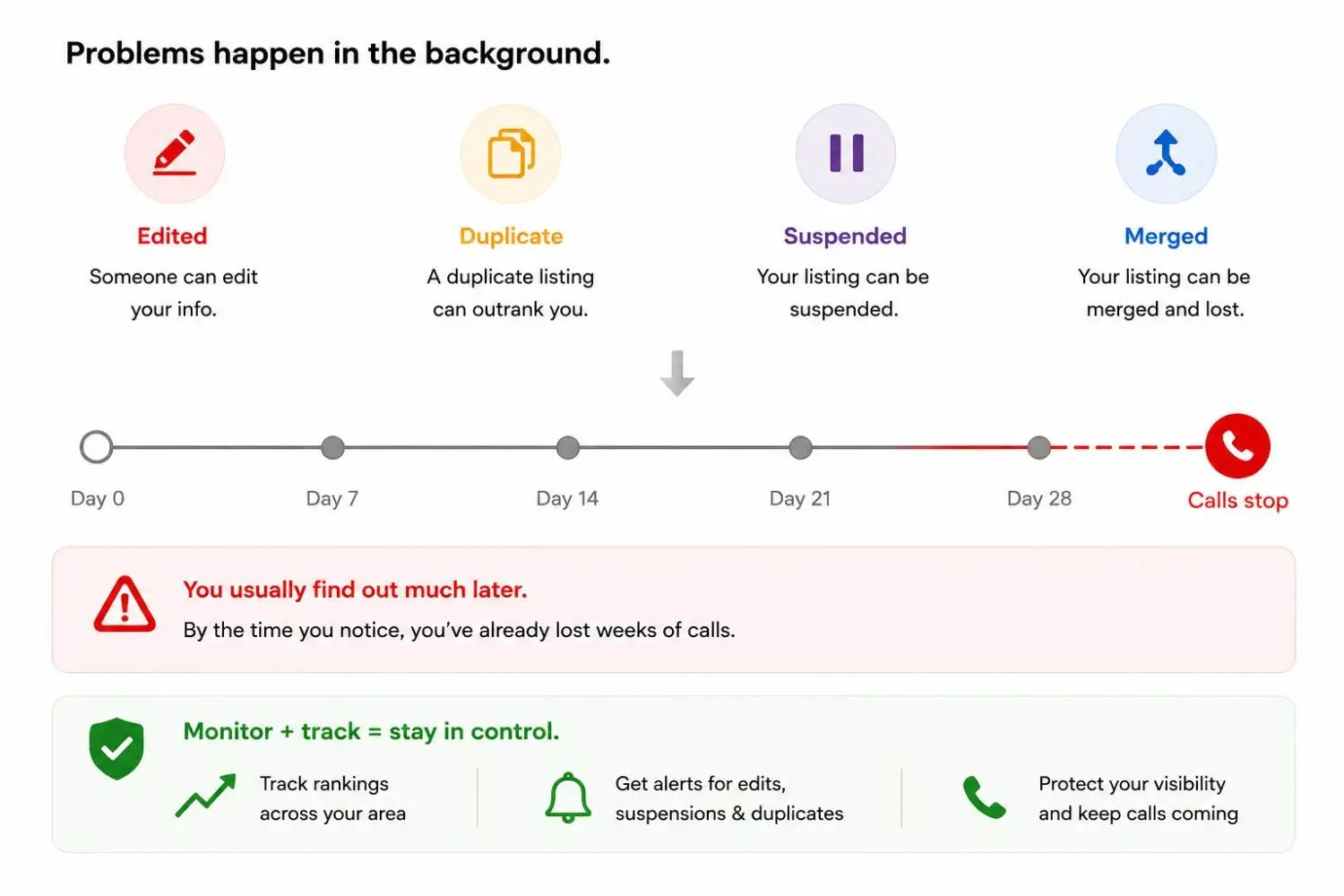
Rankings move constantly, and a listing can be suspended, edited by a stranger, or quietly merged with a duplicate without anyone noticing for weeks. Most businesses only find out when the calls stop.
Underneath: no rank tracking across the service area, and no monitoring for profile changes or suspensions.
The thing nobody explains
You search your own business and you’re right there at the top. A customer two towns over searches the same thing and can’t find you. Both of you are seeing the truth.
Why this happens
Google shows different map results depending on where the searcher is standing. Your position isn’t a single number. It’s a different number in every neighbourhood you serve.
Which means the way most businesses check their ranking — searching from their own office, is the one place they’re almost guaranteed to look good.
I measure visibility across a grid of real points throughout your service area, so we can see exactly where you’re winning, where you’re invisible, and which neighbourhoods are worth fighting for.
“I’m number one when I search. So why do customers keep telling me they couldn’t find us?”
Competitor intelligence
The businesses ranking ahead of you aren’t lucky. They’re doing specific things and those things are visible if you know where to look.
| What I compare | The business ranking #1 | Typically, you |
|---|---|---|
| Profile categories | Primary + 6 secondary, mapped to services | One category, set at signup |
| Review velocity | Steady flow, recent, responded to | Bursts when someone remembers |
| Service area coverage | A page per town they serve | One "Areas We Serve" page listing all of them |
| Local authority | Links from local press, associations, suppliers | Directory citations only |
| Profile activity | Photos, posts, Q&A kept current | Last updated when the listing was created |
| Website support | Dedicated service pages with local schema | Services listed on one page |
This is the part most providers skip. I don’t just optimize your listing. I find the specific gap between your visibility and the businesses beating you, then close it in the order that moves the phone fastest.
How I work
Most local SEO is sold as a checklist of tasks. I’d rather find out what’s actually wrong before charging you to fix things that aren’t.
Where you rank across your real service area, not just at your address and where your competitors are beating you.
Profile setup, review velocity, citation consistency, website support. Usually two or three of these, not all six.
Whatever moves the phone first gets done first. Not whatever's easiest to put on a report.
Map rankings tracked across your service area, with profile monitoring so problems get caught in days, not months.
The work itself
Google Maps is one part of it. These three areas are where most local businesses are quietly losing ground.
One of the biggest levers in local search and the one most often set up once at signup and never revisited.
In competitive markets, a perfect profile isn't enough. Sometimes the honest diagnosis is that the businesses ahead of you simply carry more local weight.
Google AI Overviews, ChatGPT, Gemini and other answer engines increasingly sit between customers and your business. They need clear, consistent information about who you are and where you work.
How you’ll know it’s working
Not a monthly PDF of green arrows. The numbers that tell you whether the work is producing customers.
Visibility
Profile activity
Website
Business outcome
Rankings are the leading indicator. Calls and leads are the business outcome.
10, 50 or 500 locations
Once you pass a handful of locations, local SEO stops being an optimization task and becomes a system. Most multi-location businesses have several locations performing far below the rest and nobody has noticed, because the group average looks fine.
Every profile configured, verified and monitored individually, not treated as one bulk upload.
Nearby branches competing with each other for the same searches, resolved deliberately.
Duplicates and merges caught before they split your reviews and rankings across two listings.
One source of truth for names, hours and phone numbers, so changes propagate instead of drifting.
Location pages that are genuinely distinct, rather than one template with the city name swapped.
Performance per branch, so underperformers surface early instead of hiding inside the average.
What actually happens
No presentation, no slide deck, no “let me tell you about our process.” I’ll have already looked at your listing before we speak.
If I don’t think I can help, I’ll tell you on the call — not in a proposal three days later.
And after that
Twenty minutes. Where you stand, and what's holding you back. No obligation either way.
If it's a fit: geo-grid mapping, profile audit, competitor gap analysis and website review..
What gets fixed, in what order, and what each one is expected to move.
The work gets done, tracked across your service area, with your profile watched for changes.
Straight answer on cost
A single-location business with one service area is a very different job from a 20-location group. Scope depends on locations, how competitive your market is and how much of the work your team can carry.I’ll give you a real number on the call not a package you have to guess your way into.
You’re paying for scope and complexity, not a longer checklist.
Profile optimization, review system, citations and the core local foundation.
Everything above, plus local authority building and an active competitor strategy.
Location architecture, per-profile management, landing pages and location-level reporting.
Scalable systems, data governance, store-level tracking and reporting your team can run.
Fair question, and worth asking. Local SEO is about making your business visible in your area where I sit doesn’t change what Google needs to see from your listing, your reviews and your website.
What does matter is that you can reach me. I keep availability during US business hours, we talk on video or by phone, and you work with me directly rather than being passed to a team you’ve never met.
Profile and listing fixes can show movement within 30–60 days, sometimes faster if something was clearly broken. Competitive markets and multi-location setups take longer — usually three to six months to settle into a stronger position.
Anyone promising results in two weeks is either lucky or lying. I’ll give you a realistic window on the call, based on what I actually see in your market.
No and neither can anyone else. Google’s local results depend on the searcher’s exact location, their history, and competitors who are also actively working on this. Nobody controls that.
What I can do is tell you honestly whether the top 3 is realistic for your market, what it would take, and how long. If it isn’t realistic, I’d rather say so than take your money for a year.
No. Long lock-ins exist to protect the provider, not the business paying. If the work isn’t producing, you shouldn’t need a lawyer to stop it.
Significantly. Multi-location businesses deal with duplicate listings, cannibalization between nearby branches, inconsistent data across dozens of profiles, and the question of how much each location’s page should differ from the others.
It’s more work, but it’s also where the biggest gains usually sit — most multi-location businesses have several locations performing far below the rest without anyone having noticed.
Not necessarily. Sometimes the existing provider is doing solid work and missing one specific thing. Sometimes they’re doing tasks that were never going to move local rankings. Either way, the review will tell you which — and you’re free to take that information back to them.
Both, because they’re not really separable. Google cross-references what your profile claims against what your website supports. A perfectly optimized listing sitting on top of a thin website will underperform, and vice versa.
More than most owners expect. A new address isn’t just a new address — your profile, citations, location pages, redirects, reviews and local signals all need to move together, in the right order.
Done carelessly, a move or rebrand can cost months of visibility that took years to build. Done deliberately, it’s one of the best times to gain ground, because your competitors aren’t touching theirs.
Increasingly, yes. People ask AI assistants for recommendations the way they used to ask a search box. How much of your market does that today depends heavily on your industry and your customers’ age, and it’s growing rather than settled.
What’s practical about it is that the groundwork overlaps with good local SEO anyway: consistent business information, structured data, clear service and area details, and content that answers real questions.You don’t need a separate AI strategy so much as information clean enough for any system to understand.
Bring it to the call. Suspensions have specific causes — usually an address issue, a name that includes keywords it shouldn’t, or a category problem and the fix depends entirely on which one it is. Reinstatement is often possible, but it’s not automatic and it isn’t fast.
Local SEO is the work of making a business visible to nearby customers searching for what it offers — primarily in Google Maps and the local pack, the small group of businesses shown above the regular results.
It differs from standard SEO because the ranking factors are different. Proximity, Google Business Profile completeness, review quantity and recency, and the consistency of your business information across the web all matter here in ways they don’t for a national website.
The local pack is the map with three business listings that appears near the top of the results for searches with local intent — “plumber near me”, “dentist in Austin”.
It matters because it sits above the standard results and captures a large share of clicks and calls for these searches. For most local businesses, being in the local pack is worth more than ranking first in the regular listings below it.
A Google Business Profile is the listing that controls how your business appears in Maps and the local pack — name, categories, services, hours, photos, reviews and posts.
It’s one of the most important assets in local search. Categories in particular are frequently set once at signup and never revisited, which quietly limits which searches a business is eligible to appear for at all.
Yes, and in more ways than most owners expect. Quantity matters, but so does recency, how often new reviews arrive, and what customers actually describe in them. Responding doesn’t work as a ranking lever on its own, but it does show both customers and Google that the business is active.
A steady flow of recent reviews generally outperforms a large number of old ones — which is why a review system matters more than a one-time push to collect them.
Start here
Twenty minutes. I’ll have looked at your listing before we speak and you’ll leave knowing exactly what’s holding you back, whether we work together or not.
No contract · No obligation · Limited number each month